FDA Staff Made a Safety Case Against Compounding BPC-157 and TB-500. Here Is What It Says.
BPC-157 safety, as FDA staff set it out for the July 2026 compounding advisory meeting: quality, immunogenicity and missing human data. No final decision.
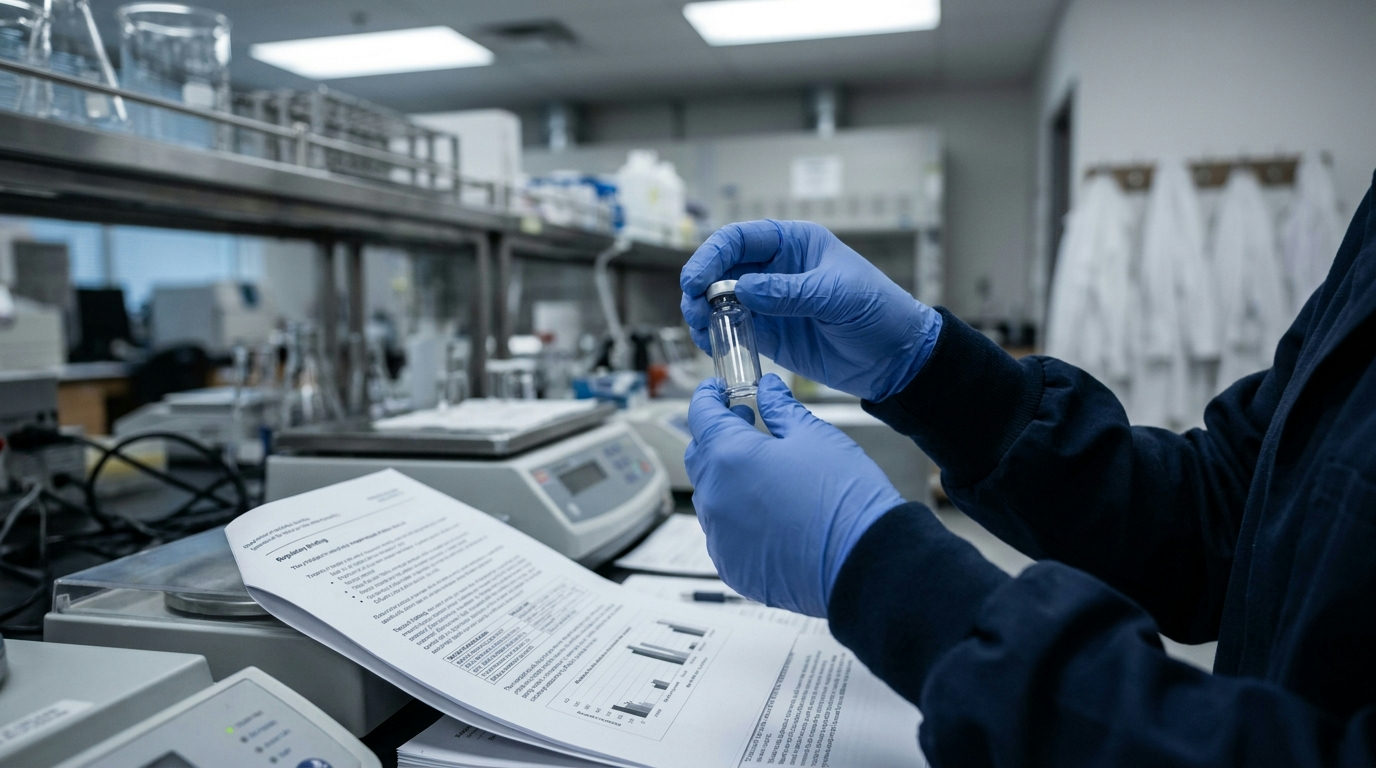
Going into its July 23–24, 2026 advisory committee meeting, FDA staff proposed that BPC-157 and TB-500 should not be placed on the 503A bulks list, citing unresolved quality and immunogenicity concerns and little or no human safety data. As of 28 September 2026, the agency has made no final decision.
What happened
FDA's Pharmacy Compounding Advisory Committee met at the agency's White Oak campus on 23 and 24 July 2026 to consider seven peptides for the 503A bulks list, the list of ingredients that state-licensed pharmacies may compound from when no USP monograph or approved-drug component applies. The Federal Register notice of 16 April 2026 listed the substances and the uses FDA reviewed: BPC-157 (ulcerative colitis), KPV (wound and inflammatory conditions), TB-500 (wounds), MOTs-C (obesity and osteoporosis), emideltide or DSIP, Semax and Epitalon.
For every one of the seven, in both free-base and acetate forms, FDA's points to consider state that the agency "is proposing" the substance "NOT be included" on the list. The committee was asked to vote on each form separately, according to FDA's posted questions. As of 28 September 2026, the FDA meeting page, last updated 6 August 2026, carries briefing documents, the agenda, the roster and FDA presentations, but no official minutes or vote record.
That gap matters. Press accounts of the meeting describe votes that did not follow the staff proposal for several substances. We report votes from the official record, not from secondhand tallies, and will update this story when FDA posts it. Advisory committee votes are recommendations in any case: FDA is not bound by them.
BPC-157 safety: what FDA's briefing says
FDA's BPC-157 briefing document concludes that "a balancing of the criteria weighs against" listing either form. Its main points:
- Identity. BPC-157 is a common name, not an adopted drug name, and FDA says it has encountered multiple salts and derivatives, including different active moieties, sold under that name. The agency calls this "a safety risk for patients as they may be dosed with a different bulk drug substance than the physician ordered."
- Quality data. FDA judged both forms "not well-characterized", citing missing or inadequate data on peptide-related impurities, aggregates, bioburden and bacterial endotoxins.
- Immunogenicity. For injectable or nasal use, FDA wrote that BPC-157 "may pose a significant risk for immunogenicity, potentially amplified by aggregation as well as potential peptide-related impurities."
- Preclinical evidence. Rat studies report protective effects against induced gut and liver injury, but FDA notes that dose-response has not been established and that the molecular targets and mechanism are still unknown. In 28-day animal toxicity studies, FDA flagged what it called "clinically relevant safety signals", including altered clotting times and liver-associated changes. It found no carcinogenicity studies.
- Clinical evidence. FDA identified five small, short human studies. It reports that no serious adverse events appear to have been reported in them, but says safety monitoring for most was unclear.
- Adverse-event reports. A FAERS search through 4 December 2025 returned three reports, all involving injectable BPC-157. One involved a BPC-157/TB-500 product labelled "research purposes only" and describes hyperpigmentation that returned on rechallenge. FDA says causality cannot be assigned to either peptide in that case, and that FAERS data alone cannot support definitive safety conclusions.
The safety case on TB-500
FDA's TB-500 briefing document is starker because the record is thinner. The agency says it found no human pharmacokinetic studies, no clinical studies or human exposure data by any route, and no nonclinical toxicity studies. It found no FAERS reports. It concludes that "potential safety risks associated with the use of these substances in humans are unknown" and that it is "particularly concerned about the absence of human data." It also says that preclinical pharmacological evidence for wound repair is lacking.
What FDA said about the other five peptides
FDA's briefing document for each of the other five reaches the same conclusion, that "a balancing of the criteria weighs against" listing either form, and judges both forms "not well-characterized." FDA's main stated concerns differ by substance:
- KPV. FDA's KPV briefing document says it is "particularly concerned about the lack of any human data on drug products containing these substances administered via any route of administration" and that "potential safety risks associated with the use in humans are unknown."
- MOTS-c. FDA's MOTS-c briefing document says the nonclinical studies "were limited to in-vitro and in-vivo rodent models" and that the molecular targets "remain unknown." It found no human data, and notes that MOTS-c "is listed as a prohibited substance in the Global DRO Database."
- Emideltide (DSIP). FDA's emideltide briefing document calls the insomnia studies "inconclusive and at best preliminary." It warns that "stimulation of the opioid system by emideltide-related BDSs could lead to development of addiction" and says it found no nonclinical studies on that potential. Studies in people with withdrawal symptoms reported headache, nausea, vertigo and cases of hypotension.
- Semax. FDA's Semax briefing document flags a mouse finding that Semax "potentiated amphetamine-induced dopamine release in the striatum", a response it says is typical of drugs of abuse. It says possible anti-thrombotic properties raise "concern about the risk of bleeding", and it found no human pharmacokinetic studies by any route.
- Epitalon. FDA's Epitalon briefing document says the mouse studies "do not adequately inform the genotoxic or the carcinogenic potential of epitalon." It calls this "concerning" because Epitalon has been shown to activate telomerase and lengthen telomeres, and "longer telomeres are generally associated with increased risk for cancer."
How this relates to Category 2
Both peptides used to sit in Category 2, FDA's list of nominated substances that may present significant safety risks. FDA's Category 2 page (content current as of 22 April 2026) now lists BPC-157, TB-500 and others under "Bulk drug substances nominated but withdrawn." The safety language remains. For BPC-157, the page says the agency "lacks sufficient information to know whether the drug would cause harm when administered to humans." For TB-500, it says FDA has not identified any human exposure data. The July briefing documents note that the nominations were withdrawn but that FDA chose to evaluate and present the substances anyway.
How the list works, and what comes next
FDA's briefing introduction says each nominee is judged on four criteria set by a February 2019 final rule: physical and chemical characterization, safety, evidence of effectiveness, and historical use in compounding. FDA applies "a balancing test", weighing them "on a substance-by-substance basis."
FDA's 503A bulks page (content current as of 14 May 2026) says the 2019 rule placed six substances on the list and declined four, and that FDA will address other nominees "on a rolling basis through notice-and-comment rulemaking." On that description, any decision on these seven would appear first as a proposed rule open for public comment. The briefing introduction adds that the final determination "may be affected by issues not discussed at the advisory committee meeting."
What this does not say
- It is not a final decision, and it is not the committee's view. The briefing documents are FDA staff's proposal to the committee. FDA's briefing introduction says it does not intend to issue a final determination until the committee's input has been considered and all reviews are finalised. FDA's 503A bulks page says substances are added to the list through notice-and-comment rulemaking. As of 28 September 2026, we found no such proposed rule in the Federal Register.
- It is not a finding of proven harm. FDA's position rests mainly on missing data, uncertain product quality and theoretical immunogenicity risk. It is not based on a demonstrated pattern of injuries.
- It does not rule out benefit. The preclinical literature FDA summarised reports effects in animals. FDA's point is that this has not been established in people.
- It says nothing about approval. Neither substance is a component of an FDA-approved drug, and a bulks listing would not make either one approved.
In the BPC-157 briefing document, FDA says 503A compounders generally do not report adverse events to it, and it encourages compounders, clinicians and consumers to report problems with compounded drugs to MedWatch.
This article reports regulatory documents. It is educational only and not medical advice. Questions about any compound belong with a licensed clinician.
Related
Sources
- 1.FDA — July 23-24, 2026: Meeting of the Pharmacy Compounding Advisory Committee (page updated 6 August 2026)
- 2.FDA — PCAC Briefing Document: Introduction and Points to Consider (July 2026)
- 3.FDA — PCAC Briefing Document for BPC-157-Related Bulk Drug Substances (July 2026)
- 4.FDA — PCAC Briefing Document for TB-500-Related Bulk Drug Substances (July 2026)
- 5.FDA — PCAC Meeting Questions (July 23-24, 2026)
- 6.Federal Register — Pharmacy Compounding Advisory Committee; Notice of Meeting (16 April 2026)
- 7.FDA — Certain Bulk Drug Substances for Use in Compounding that May Present Significant Safety Risks (content current as of 22 April 2026)
- 8.FDA — Bulk Drug Substances Used in Compounding Under Section 503A of the FD&C Act
- 9.FDA — PCAC Briefing Document for KPV-Related Bulk Drug Substances (July 2026)
- 10.FDA — PCAC Briefing Document for MOTS-c-Related Bulk Drug Substances (July 2026)
- 11.FDA — PCAC Briefing Document for Emideltide-Related Bulk Drug Substances (July 2026)
- 12.FDA — PCAC Briefing Document for Semax-Related Bulk Drug Substances (July 2026)
- 13.FDA — PCAC Briefing Document for Epitalon-Related Bulk Drug Substances (July 2026)
The peptide story, reported straight
Every Friday. Independent coverage of the science, the safety and the FDA story. No vendors, no affiliate links, no hype.
Unsubscribe anytime. We never sell your address.